On 18 November 2026, the Dutch farming paper Nieuwe Oogst ran an article on seeding and fertilising with a drone. Farmer Pieter Gistelinck from Ooike, Belgium, describes his first season with his XAG P150 Max. Bert Depraeter of Agri Drones explains what the machine can do, what it delivers and where regulations still hold things back.
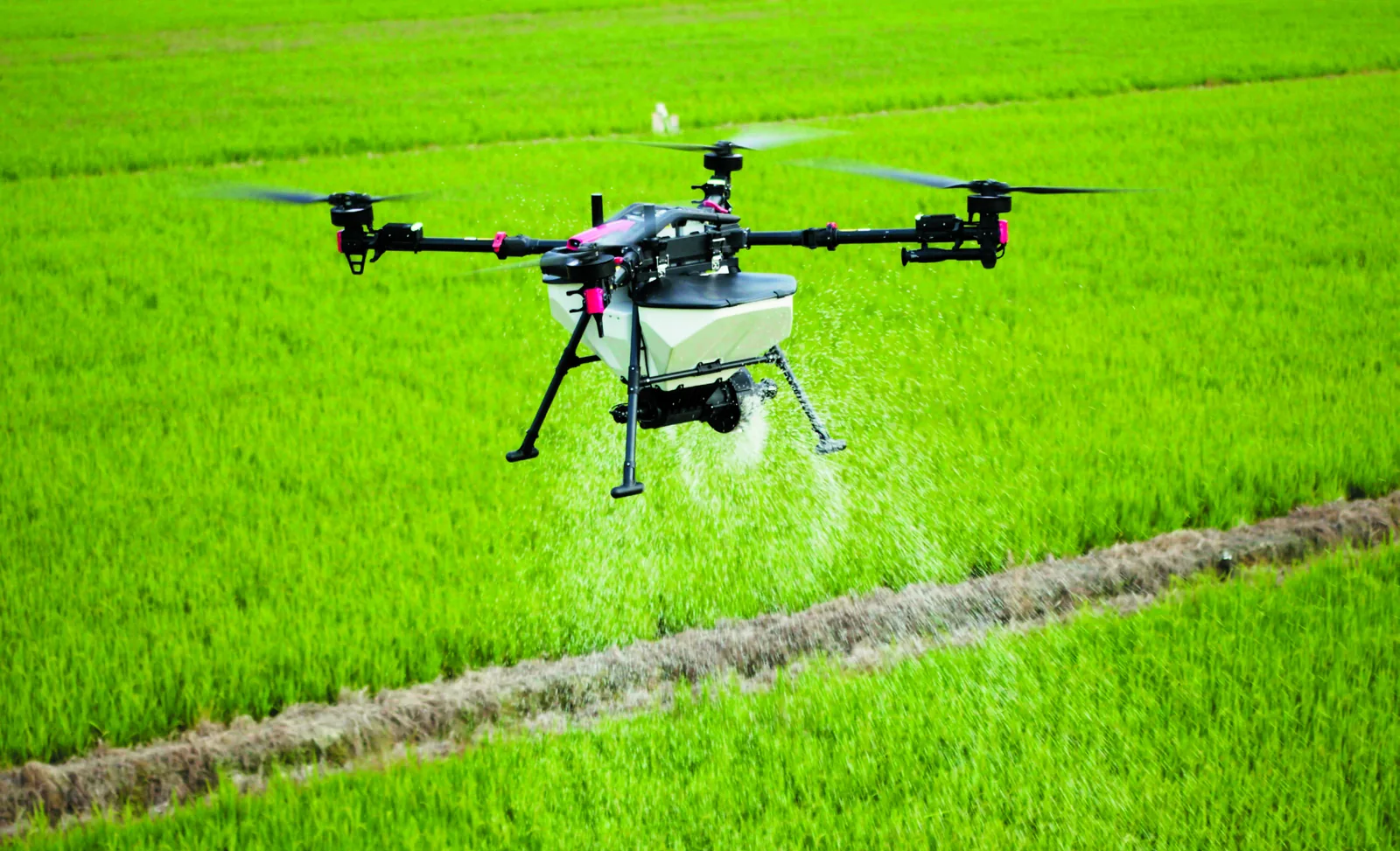
Sowing earlier, without compacting the soil
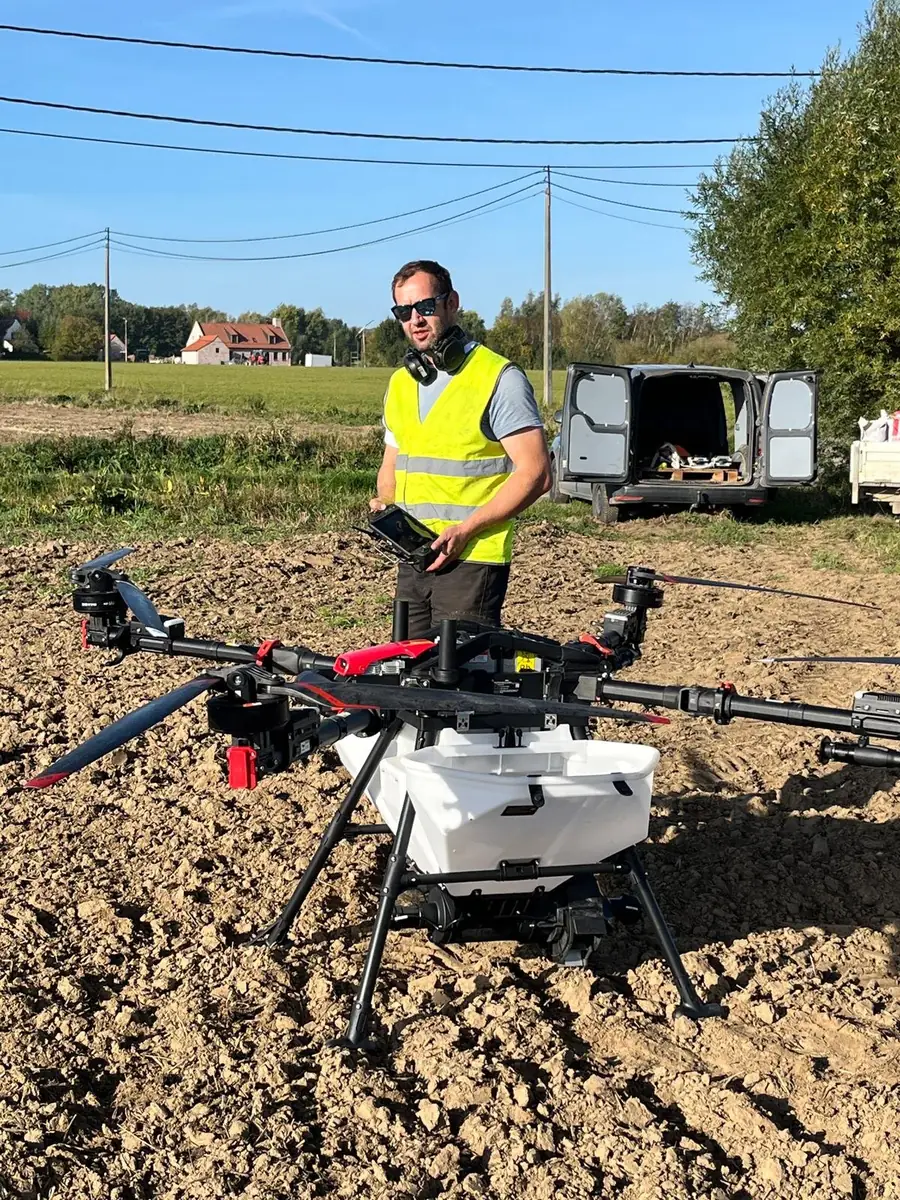
For Pieter, the biggest gain is time and flexibility. He can start undersowing and fertilising earlier in the season, without driving heavy machinery over the field. This year he used the drone for the first time to sow winter barley, winter wheat, green manures and undersown crops. He told the paper he was surprised by how well the crops came up.
His fields lie in the Flemish Ardennes, where erosion on slopes is a concern. When he sows grass into the cereal crop, the soil is already full of roots at harvest and the field stays covered through the winter. For Pieter, carbon farming and sky farming go together: more carbon in the soil, fewer inputs and more targeted work.
Read our own interview with Pieter too: Pieter Gistelinck seeds with the XAG P150 Max.
What the P150 Max does
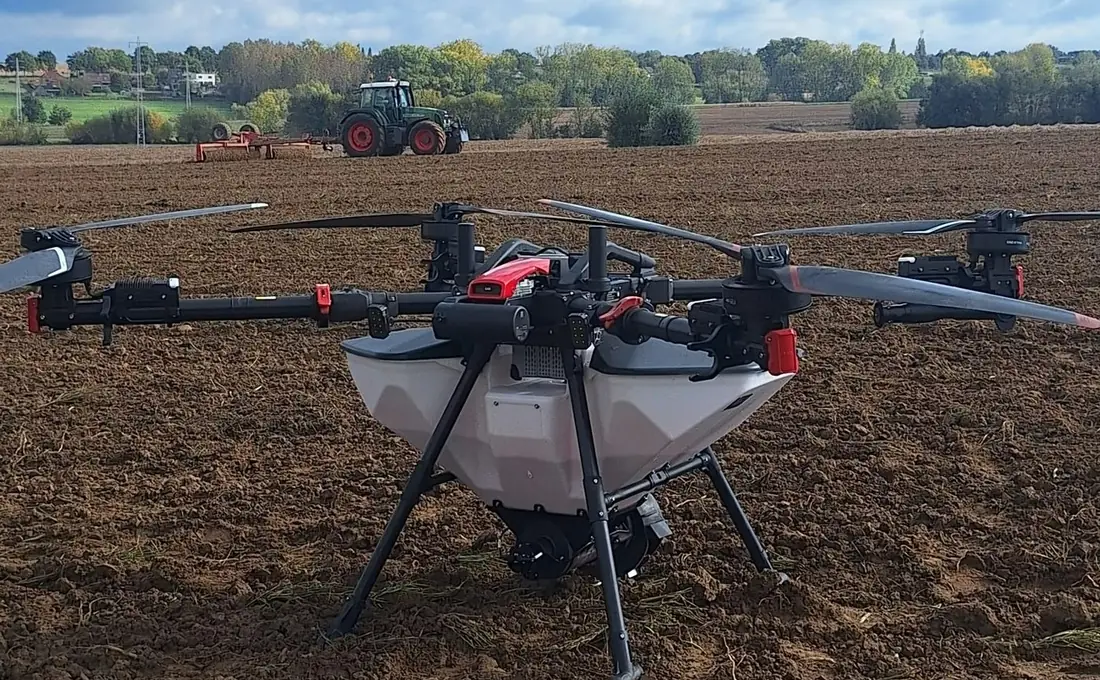
The XAG P150 Max carries up to 80 kg per flight and, according to Bert, seeds around 5 hectares per hour. It spreads grass seed, rapeseed, pelleted vegetable seed and mineral fertiliser, among other things. Fine powdery seed needs a separate metering unit.
With RTK the drone flies to within about 10 cm, which keeps overlap and missed strips to a minimum. You set the rate, spreading width and flight route beforehand, and calibrate the seeding unit in the XAG One app. A battery charges in 7 minutes, and with three battery packs the drone never has to wait. When the battery or the hopper is almost empty, it returns by itself and picks up its route again after the swap or refill.
For wheat, Pieter sows 150 to 180 kg per hectare. That takes two passes: one in one direction, then one across it. A slightly bigger tank would be nice, he says, though 80 kg per flight is already a lot.
Next season: fertilising with prescription maps
Next season Pieter also wants to use the drone for fertilising. Instead of spreading 200 to 250 kg of calcium ammonium nitrate (CAN) per hectare in one go, he plans to split the dose over several moments using prescription maps. That way the wheat only gets the nitrogen it needs at that moment.
A prescription map can be made beforehand with a mapping drone and then loaded into the XAG drone, or drawn by hand in the XAG One app or on the remote control. Agri Drones also makes these maps for customers, in cells of 5 by 5 metres: see the Agri Drones Taakkaarten app.
What does it deliver?
Bert does not give a fixed cost per hectare, because it depends heavily on the crop and the field. The savings come mainly from accurate application: 20 to 30 percent less fertiliser. On top of that, Agri Drones counts on 5 to 15 percent more yield thanks to a more even crop. Less labour and no wheel compaction also add up.
In an Agri Drones calculation for a 50 hectare farm with five applications a year, the savings come to around 6,000 euros a year. That pays back the investment within 3.7 years. The more hectares you cover with the drone, the faster that goes. Prices and packages are in our webshop.
Regulations
Drones above 25 kg, such as the P150 Max, fall under EASA's Specific category. To seed and fertilise you need, among other things, an operator registration, an operator certificate, a SORA risk assessment and an operational authorisation. Spraying is subject to stricter rules: in Belgium only biostimulants and biodegradable products are allowed for now.
In the article, Bert calls for more room for spot spraying, fewer restrictions in controlled airspace for certified pilots, subsidies for agricultural drones and a simpler renewal of pilot certificates. We also run pilot training: see our drone pilot training (in Dutch).
What's coming
Next year Agri Drones expects the XAG X-Series. The drone is activated remotely and takes off by itself from a base station that mixes the spray solution and recharges and refills the drone. The grower supplies power, water and concentrate and follows the work online.
Pieter notices that interest is growing. He gets more and more questions from other growers: many farmers see potential in the drone, but are still hesitant to get started.
Source: Nieuwe Oogst, 18 November 2026, Mechanisatie section, "Gerichter en flexibeler telen vanuit de lucht" (More targeted and flexible farming from the air), text: Lisanne Scheer.
Our thanks to Nieuwe Oogst for the article and to Pieter Gistelinck for sharing his experience.
Want to see what a drone can do on your fields?
Agri Drones, based in Tielt, is the official XAG dealer for the Benelux. We'll come to your own fields for a demo and support you during start-up. If you choose a P150 Max after the demo, we'll deduct the demo rental from the purchase price.